PyMC-Marketing isn't a fixed model the way Robyn and Meridian are — it's a kit you assemble: which decay curve, which saturation curve, which priors, which sampler settings. That flexibility is the point (and the tradeoff): if you don't have a specific reason to want that control, Robyn or Meridian will get you a result with far fewer decisions to make.
Connecting it
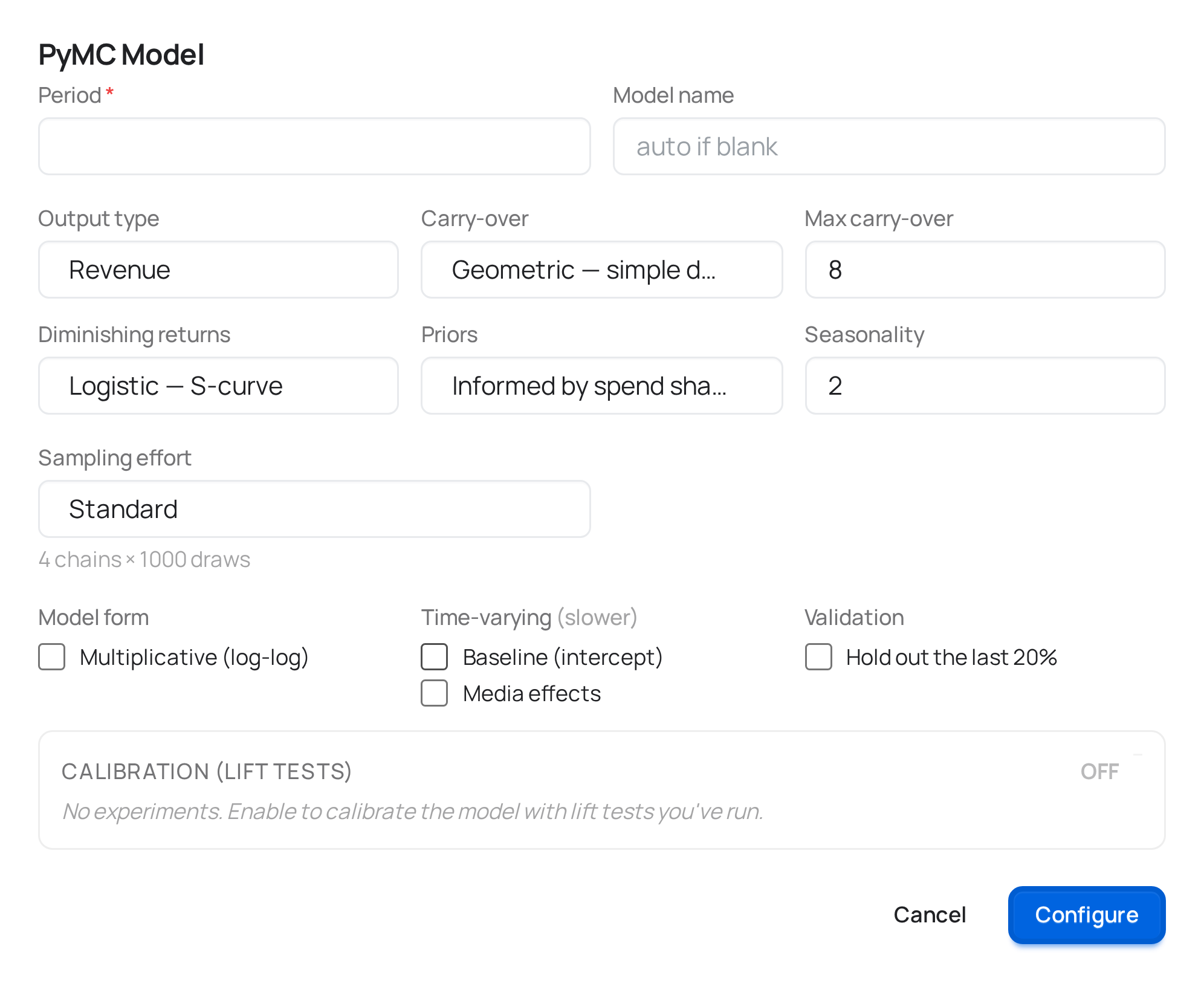
Drag a PyMC node off Period (or directly off Variables). The modal has two modes:
- Guided — a form with the fields below. Recompiles into the model spec every time you save, so it's never out of sync with what you see.
- Advanced — a raw JSON editor for the same spec, for when a setting you need isn't exposed as a guided field. meryn validates it before saving, so a malformed spec is rejected with an error rather than accepted and failing later during training.
Adstock (carryover)
| Field | Default | What it controls |
|---|---|---|
| Adstock kind | Geometric | The shape of how a channel's effect decays after spend stops. Geometric is a single-parameter exponential decay — the same family Robyn uses, and a reasonable default. Other options: Delayed (effect peaks after a lag rather than immediately), Weibull (CDF or PDF) (more flexible decay shapes, more parameters to fit), Binomial, or None (no carryover — same-period effect only). |
| Max lag | 8 (range 1–52) | The longest carryover window considered, in your data's time units. |
Saturation (diminishing returns)
| Field | Default | What it controls |
|---|---|---|
| Saturation kind | Logistic | The shape of how a channel's effect flattens out as spend increases. Other options: Hill / Hill (sigmoid), Michaelis-Menten, Tanh / Tanh (baselined), Root, Log, Inverse scaled logistic, or None. If you're not choosing this for a specific reason, Logistic is the safest default. |
| Link function | Identity (additive) | Whether channel effects add up (Identity) or multiply (Log). Switching to Log restricts Saturation to Log or None — the two have to be mathematically compatible. |
Seasonality and time-varying effects
| Field | Default | What it controls |
|---|---|---|
| Yearly seasonality | 2 (0–10 Fourier modes) | How much flexibility the model has to fit a recurring yearly pattern. Set to 0 to disable seasonality entirely. |
| Time-varying intercept | Off | Lets the baseline level drift smoothly over time instead of staying fixed. Meaningfully increases training time. |
| Time-varying media | Off | Lets each channel's coefficient drift over time instead of staying fixed for the whole period. Also increases training time — combined with a high draw count in Custom sampler settings, meryn will reject the combination as too slow to run in the time available. |
Leave both time-varying options off unless you have a specific reason to believe the effect actually changed shape mid-period (a big pricing change, a channel mix shift) — they're the most expensive knobs in this modal.
Priors
| Option | What it means |
|---|---|
| Spend-informed (default, recommended) | Sets each channel's starting belief in proportion to its share of total spend — a sensible, data-driven default with no manual input needed. |
| Default | PyMC-Marketing's own out-of-the-box priors, with no adjustment for your data. |
| Custom | A per-parameter editor if you have specific prior beliefs to encode. |
Sampler settings
| Preset | Draws / Tune / Chains | Target accept | When to use it |
|---|---|---|---|
| Quick | 500 / 500 / 2 | 0.90 | Fast iteration while you're still deciding on the model structure — expect noisier convergence diagnostics. |
| Standard | 1000 / 1000 / 4 | 0.90 | The default balance of speed and reliability for most models. |
| Thorough | 2000 / 2000 / 4 | 0.95 | A final run once you're happy with the structure and want the most reliable result. |
| Custom | You choose draws, tune, and chains (up to 4) individually, plus target accept (0.5–0.99) and the sampler (nutpie or pymc) |
— | When you need something between or beyond the presets. |
Holdout validation
| Field | Default | What it controls |
|---|---|---|
| Holdout validation | Off | Scores the model on data it didn't train on. |
| Holdout fraction | 10% / 20% / 25% | The final stretch of the date range, held out — the same "last block of dates" approach as Robyn, unlike Meridian's scattered holdout. |
Calibration (optional)
Same lift-test mechanism as Robyn: add a channel, a date range, tested spend, and measured lift, and meryn validates the row against your actual spend data live. Two differences from Robyn's version: PyMC only calibrates paid channels (organic and contextual columns enter as covariates, not as something with a saturation curve to calibrate), and each lift-test row covers exactly one channel rather than letting you sum several into one test.
Reading convergence
PyMC results include a convergence verdict (converged / did not converge) based on standard Bayesian MCMC diagnostics — r-hat, effective sample size, and divergences. This is the one place across the three engines where meryn applies its own threshold rather than reading a verdict the framework provides directly (Meridian ships its own built-in reviewer; Robyn doesn't use MCMC at all, so the concept doesn't apply). Treat a "did not converge" result as a reason to increase draws/tune (try Thorough, or a Custom preset with a higher target accept) before trusting the model's numbers.
v1 scope: national data only
Geo-level modeling isn't available yet for PyMC — train on nationally aggregated data, same as the other two engines.
What connects here
Upstream: Period or Variables. Downstream: Budget allocator or Benchmark.